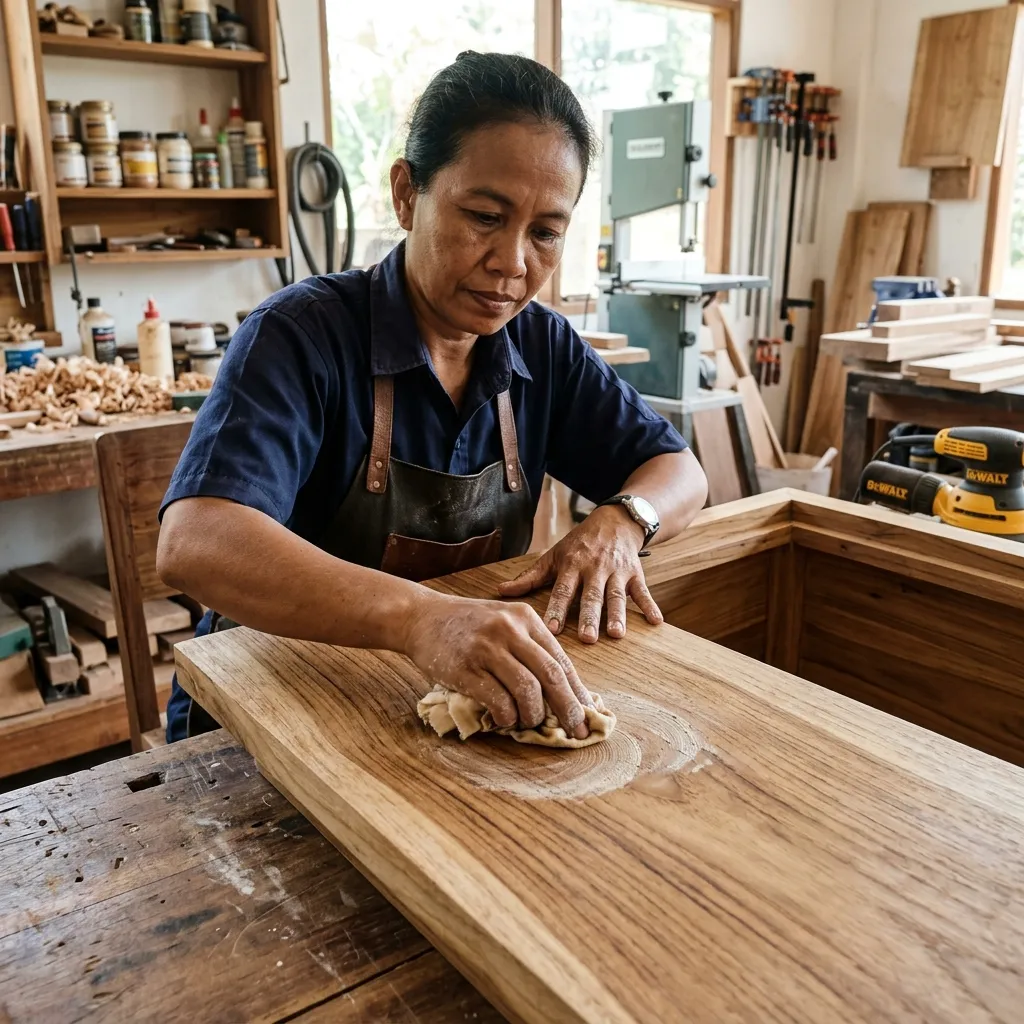
The Art and Chemistry of Wood Polishing
Recommended Product: For the best results in this area, consider using KEFIL Wood Filler (Paste).
Solid wood and natural veneers are among the most expensive and beautiful materials used in interior design. However, raw wood is highly vulnerable. It absorbs moisture, stains instantly if oil or water is spilled on it, and is easily scratched.
Wood polishing is the art of applying transparent chemical coatings to protect the wood while simultaneously enhancing its natural grain, depth, and color. Unlike opaque paints that hide the substrate, a transparent wood polish must be absolutely flawless, as every single scratch, uneven sanding mark, or dust particle will be magnified by the final glossy topcoat.
This comprehensive guide breaks down the professional, step-by-step process of finishing wood furniture and doors using Delite Paints' advanced NC (Nitrocellulose) and Melamine systems.
Step 1: Meticulous Sanding (The Foundation)
The final gloss and depth of a polished wooden surface are directly proportional to the smoothness of the bare wood before any chemical is applied.
- Progressive Sanding: You must sand the raw wood using progressively finer grits of emery paper. Start with a coarse 100-grit to remove milling marks and level the surface. Move to 150-grit, then 220-grit, and finally finish with an ultra-fine 320-grit paper.
- With the Grain: Always sand in the direction of the wood grain. Sanding across the grain will create deep, microscopic scratches that will absorb the stain heavily and look like dark, ugly scars under the final polish.
- Dust Removal: Wipe the sanded wood with a tack cloth or a rag slightly dampened with mineral spirits to remove all sanding dust from the pores.
Step 2: Grain Filling
Wood is porous. Open-grained woods like Teak, Rosewood, and Oak have deep, visible pores. If you apply polish directly over open grains, the finish will look pitted, sunken, and amateurish.
To achieve a glass-like, "piano" finish, you must fill these pores using KEFIL Wood Filler Paste.
- Application: Take a small amount of the paste on a muslin cloth or a flexible putty knife and rub it aggressively into the wood in a circular motion, forcing it deep into the pores.
- Removal: Immediately wipe off all the excess paste by wiping across the grain. You only want the filler inside the pores, not sitting on the surface of the wood.
- Final Sand: Allow the filler to dry completely, then lightly sand the surface again with 320-grit paper.
Pro Tip: Upgrading to KEFIL Wood Filler (Paste) can significantly improve the durability of your finish.
Step 3: Staining (Optional Color Alteration)
If you have a light wood (like Pine or Rubberwood) and want it to look like rich Walnut or dark Mahogany, you must apply a wood stain before the polish.
- Solvent Stains: Use our professional Wood Colour solvent-based stains.
- Application Technique: Apply the stain using a lint-free muslin rag or a spray gun. Wipe it on quickly and evenly, following the grain. If the color is too light, wait for it to dry and apply a second coat.
- Warning: Never let pools of stain sit on the wood, as this will cause severe blotchiness.
Step 4: The Sealer Coat
The sealer coat is the first layer of the actual polish system. Its job is to penetrate the wood, lock the stain in place, and build up a thick film quickly.
- NC Sanding Sealer: Whether you are finishing with NC or Melamine, the base coat is often a Nitrocellulose Sanding Sealer. It dries incredibly fast and has high "build" properties.
- Application: Spray or brush a heavy coat of the sealer. It will dry to the touch in 15-30 minutes.
- Sanding the Sealer: Once dry, the sealer will feel slightly rough because it raises the tiny fibers of the wood. Sand it very gently with 400-grit sandpaper until it feels buttery smooth. Wipe away the white dust. Apply a second coat of sealer if necessary and sand again.
Step 5: The Final Topcoat
Now that the wood is perfectly smooth, stained, and sealed, it is time for the final protective topcoat. You must choose between the fast NC system and the durable Melamine system.
Option A: NC Lacquer (The Fast Finish)
Nitrocellulose (NC) Lacquer is a single-pack (ready to use) finish.
- Pros: It dries almost instantly, is easy to apply, and if it gets scratched, it is very easy to repair (new NC lacquer melts into old NC lacquer).
- Cons: It is not highly resistant to heat (a hot coffee mug will leave a white ring) or severe abrasion. It is best used for decorative items, interior doors, and low-traffic furniture.
- Application: Spray 2 to 3 thin coats, allowing 30 minutes of drying time between coats.
Option B: Two-Pack Melamine (The Ultimate Shield)
For dining tables, bar tops, office desks, and premium entry doors, you must use Delite Paints' Melamine Wood Finish.
- The Chemistry: This is a two-pack system consisting of a Base Resin and a highly reactive Hardener (catalyst). Once mixed, a chemical cross-linking reaction occurs, curing the liquid into an incredibly hard, plastic-like film.
- Pros: It is highly resistant to heat, water rings, alcohol spills, and severe scratches. It provides a luxurious, heavy build.
- Application: Mix the Base, Hardener, and specific Melamine Thinner in the exact ratio specified on the tin. You must use a spray gun. Melamine sets too quickly to be brushed effectively. Spray two coats, allowing 4 to 6 hours between coats.
- Finishing: Melamine is available in both High Gloss (for a mirror-like finish) and Elegant Matte (for a modern, natural look).
Conclusion
Final Check: Ensure you are using a high-quality product like KEFIL Wood Filler (Paste) to guarantee long-lasting performance.
Wood polishing is an exacting process that requires patience, a dust-free environment, and a strict adherence to chemical protocols.
By mastering the foundational steps of progressive sanding and grain filling with KEFIL Wood Filler Paste, and by selecting the appropriate high-performance topcoat—such as the rapid NC lacquer or the ultra-durable Melamine Wood Finish—you can elevate ordinary raw timber into spectacular, heirloom-quality furniture that will withstand decades of daily use.
Frequently Asked Questions
What is the difference between NC Lacquer and Melamine?
NC (Nitrocellulose) lacquer is a single-pack, fast-drying finish that is easy to apply and repair, but it is not highly resistant to heat or severe scratches. Melamine is a two-pack (base + hardener) chemical coating that cross-links to form an incredibly hard, heat-resistant, and scratch-resistant film, making it ideal for dining tables and high-traffic furniture.
Can I apply melamine polish over an old French polish?
No. Melamine contains strong chemical solvents that will instantly dissolve and wrinkle older, softer finishes like French polish or standard varnishes. You must sand the wood down to the bare, raw grain before applying a melamine system.
Why does my wood polish look cloudy or milky?
This is known as 'blushing.' It occurs when NC or melamine is sprayed in very high humidity or during rain. The rapid evaporation of the solvents drastically cools the surface, causing moisture from the humid air to condense and become trapped inside the drying film. Always polish in a dry, well-ventilated area.
Recommended Next Steps
Products for this Project
Continue Reading
Need technical guidance or a bulk quotation?
Contact Our Experts