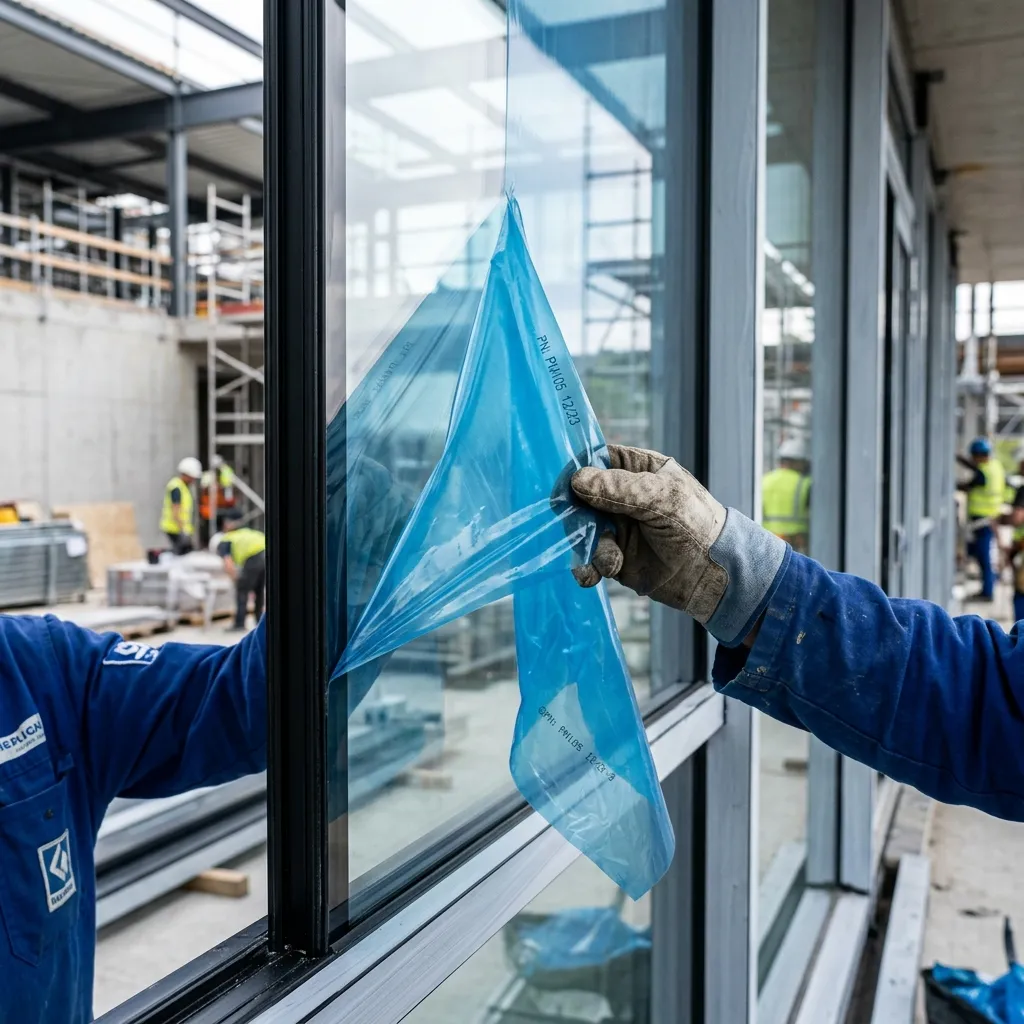
The Nightmare of Surface Damage During Construction
Recommended Product: For the best results in this area, consider using KIP Protective Peelable Coating.
Every major construction, renovation, or manufacturing project involves coordinating multiple trades—masons, welders, painters, and carpenters—working in close proximity. Amidst this chaos, highly valuable, delicate surfaces are constantly at risk.
Imagine installing expensive floor-to-ceiling glass windows or pristine brushed aluminum elevator doors, only to have them ruined days later. A mason might splash highly alkaline cement mortar onto the glass, etching the surface permanently. A welder’s stray spark can instantly pit a stainless steel railing. A painter’s overspray can ruin the finish of an acrylic panel.
Replacing these damaged components at the end of a project costs thousands of rupees and causes massive delays. Protecting them is absolutely essential.
Why Traditional Masking Fails
Historically, the construction industry has relied on two methods for temporary surface protection: masking tape and plastic polyethylene sheets (or bubble wrap). While cheap, these methods have severe, costly limitations.
1. The Adhesive Residue Problem
Standard masking tape and pre-applied protective films use chemical adhesives to stick to the surface. When left on a window or an aluminum frame for months—especially under the baking Indian sun—the adhesive breaks down and bakes into the substrate. When you try to remove the tape at the end of the project, it leaves behind a stubborn, sticky residue that requires harsh chemical solvents and hours of intense scrubbing to remove, often scratching the surface in the process.
2. Physical Tearing and Wind Damage
Taping plastic sheets over large windows is incredibly tedious. Furthermore, plastic sheets are fragile. They tear easily when brushed against by workers or equipment. In high-rise construction, the wind easily catches under the edges of taped plastic sheets, ripping them off entirely and leaving the surface completely exposed.
3. Complex Geometries
Try taping a piece of plastic perfectly around a curved handrail, a complex architectural molding, or a finely detailed metal grille. It is nearly impossible. Traditional films cannot conform to complex 3D shapes.
The Modern Solution: Liquid Peelable Coatings
To solve all of these problems, Delite Paints introduced KIP PIL Peelable Coating—a revolutionary "liquid masking tape" designed for the rigorous demands of modern construction.
What is a Peelable Coating?
KIP PIL is a specialized, liquid-applied temporary protective film. When in the bucket, it looks and behaves like a thick paint. However, its chemistry is entirely different.
Instead of permanently bonding to the substrate like a traditional paint, KIP PIL is engineered to lay flat on the surface and cure into a tough, highly elastic, skin-tight plastic membrane. It uses the physical "suction" of drying against a smooth surface to hold on tight, rather than relying on sticky glues.
Pro Tip: Upgrading to KIP Protective Peelable Coating can significantly improve the durability of your finish.
The Advantages of KIP PIL Peelable Coating
Switching from plastic sheets to a liquid peelable coating transforms how a construction site operates.
1. Absolute Conformity
Because it is applied as a liquid, KIP PIL conforms perfectly to any shape, no matter how complex. Whether you are protecting a flat pane of glass, a curved acrylic dome, or a deeply grooved aluminum extrusion, the liquid flows into every crevice, creating a seamless, custom-fit protective skin.
2. Impenetrable Protection
Once dry, the plastic membrane is incredibly tough.
- It completely blocks paint overspray and varnish drips.
- It resists the highly alkaline attack of wet cement and plaster splashes.
- It protects against minor abrasions, tool strikes, and the friction of heavy dust storms.
- It forms a complete waterproof barrier.
3. Zero Adhesive Residue
The most magical part of KIP PIL is the removal process. When the construction project is finished and the building is ready for handover, you simply scratch a corner of the film with your fingernail and pull. The entire membrane stretches and peels off in one massive, continuous sheet. Because there is no glue involved, the surface underneath is revealed in pristine, factory-new condition, requiring zero cleanup.
Step-by-Step Application Guide
Using KIP PIL is straightforward, but it requires adherence to specific application protocols to ensure it peels off correctly months later.
Step 1: Substrate Qualification
Rule #1: Only apply on non-porous surfaces. Peelable coatings work brilliantly on glass, glazed ceramic tiles, fiberglass, polished granite, stainless steel, aluminum powder-coated frames, and high-gloss baked enamels.
Do NOT apply on porous surfaces like raw wood, unpainted concrete, natural sandstone, or matte-finish paints. The liquid will soak into the pores of these materials, mechanically locking itself in, making it impossible to peel off.
Step 2: Surface Cleaning
The surface must be completely dry and free from heavy oils, grease, or standing water. While it can tolerate minor dust, oil will prevent the coating from forming a cohesive film, causing it to run or "fish-eye."
Step 3: Application Method
KIP PIL is highly versatile and can be applied using different methods depending on the scale of the job.
- Airless Spraying: For large-scale commercial jobs (like an entire glass facade), using an airless sprayer is the most efficient method. It provides a perfectly uniform, thick film.
- Rolling: For medium-sized areas like window frames or bathtubs, a high-quality short-nap roller works perfectly.
- Brushing: Use a nylon brush for small touch-ups or cutting into sharp corners.
Step 4: Achieving the Correct Thickness (Crucial)
The most common mistake made with peelable coatings is applying them too thinly. If the dried film is too thin, it will not have the tensile strength to hold together when you try to peel it. It will break off in tiny, frustrating pieces instead of one large sheet.
- Apply a thick, generous wet coat.
- You are aiming for a Dry Film Thickness (DFT) that feels like a thick balloon or a heavy-duty plastic shopping bag. If in doubt, apply a second coat once the first has dried.
Step 5: Curing and Removal
Allow the coating to cure for 2 to 4 hours depending on humidity and airflow. It will dry to a tough, resilient finish. Months later, when the site is clean and dust-free, simply grab an edge and slowly peel the film away to reveal your perfectly protected surface.
Conclusion
Final Check: Ensure you are using a high-quality product like KIP Protective Peelable Coating to guarantee long-lasting performance.
In the fast-paced, high-stakes environment of construction and manufacturing, protecting your finished surfaces shouldn't be an afterthought. Relying on outdated tapes and plastic sheets guarantees adhesive damage, wasted labor, and frustrated clients.
By adopting KIP PIL Peelable Coating, you are deploying a modern, engineered solution. You can proceed with messy construction tasks—plastering, welding, and painting—with absolute confidence, knowing that a single pull of a plastic film will reveal a flawless, damage-free surface underneath.
Frequently Asked Questions
Does a peelable coating leave adhesive residue when removed?
No, this is its primary advantage over traditional masking tape or plastic films. KIP PIL Peelable Coating is a liquid plastic that cures into a solid sheet. Because it does not use chemical adhesives to stick to the surface, it peels off 100% cleanly without leaving any sticky residue behind.
Can I use peelable coating on porous surfaces like wood or concrete?
No. Liquid peelable coatings are designed strictly for non-porous surfaces like glass, glazed ceramics, aluminum, stainless steel, and high-gloss plastics. If applied to raw wood or concrete, the liquid will seep into the pores and you will not be able to peel it off.
How long can I leave the peelable coating on the surface?
KIP PIL is formulated to withstand the duration of a standard construction project, typically up to 6 to 12 months. However, if exposed to direct, intense UV sunlight outdoors for prolonged periods beyond its rating, it may become brittle and difficult to peel.
Recommended Next Steps
Products for this Project
Continue Reading
Need technical guidance or a bulk quotation?
Contact Our Experts